
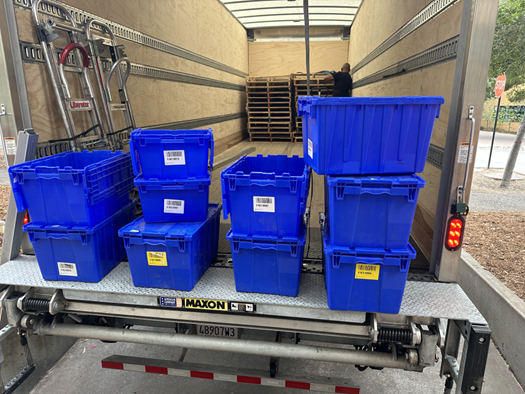
Same Supplies, Better Box: Closing the Loop on Campus Shipping
How one campus building manager is rethinking the supplies behind scientific discovery –helping labs be more circular.
The campus electric load is forecasted to exceed 80% capacity each day this week. Please reduce electricity from 2 to 6 p.m. this week to protect our overall campus power supply. (sustainable.stanford.edu/power-smart)

Stanford staff, faculty, students, and alumni came together in May for the inaugural Residential & Dining Enterprises (R&DE) Stanford Food Institute (SFI) research symposium: Advancing Food Systems Change at Stanford and Beyond. Founded by Dr. Shirley Everett, senior associate vice provost for R&DE and senior advisor to the provost on equity and inclusion, SFI’s mission is to advance research, education, policy, and business, and to promote a holistic approach to improving what people eat, how they access food, and the role that food plays in our lives. Dr. Everett’s compelling vision and continued strategic leadership of this expansive research platform is bringing to fruition SFI’s goal of creating a brighter food future that supports a diverse and inclusive community.
The groundbreaking Research Symposium showcased food systems research in an interactive, exhibition-style format with presentations from more than 73 researchers from all seven schools — as well as Stanford Impact Labs, Stanford Healthcare, the Scope 3 Emissions Program, SFI, and other departments across campus. The diverse array of project topics ranged from soil health, water, urban agriculture, aquaculture, food allergies, food justice, and tribal food sovereignty, to food as medicine, fermented foods, school food programs, dining hall choice architecture, food-related greenhouse gas emissions, plant protein preferences, food waste, and more.
This exciting convention not only showcased these researchers’ interdisciplinary, collaborative work, but also cultivated community and fostered new collaborations. The enthusiasm and energy of the presenters and attendees was palpable, and SFI looks forward to expanding the reach of the annual symposium and engaging the food systems community at Stanford and beyond.
How one campus building manager is rethinking the supplies behind scientific discovery –helping labs be more circular.
There is no excerpt because this is a protected post.
There is no excerpt because this is a protected post.