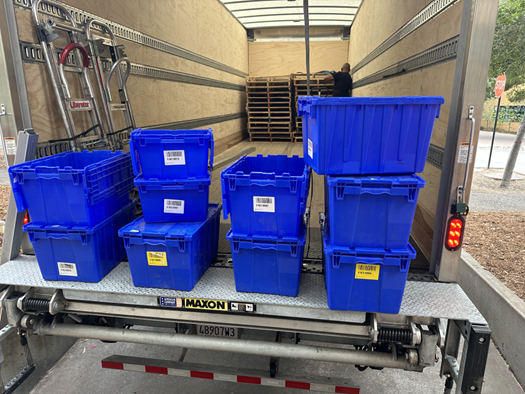
Same Supplies, Better Box: Closing the Loop on Campus Shipping
How one campus building manager is rethinking the supplies behind scientific discovery –helping labs be more circular.
The campus electric load is forecasted to exceed 80% capacity each day this week. Please reduce electricity from 2 to 6 p.m. this week to protect our overall campus power supply. (sustainable.stanford.edu/power-smart)

Give and claim lab supplies and equipment through Stanford’s Property Reuse Slack channel or make use of Stanford ReUse, our site where Stanford owned property can be posted and claimed for free within the Stanford community. You can contribute to the reuse and sharing economy by posting items throughout the year and making it your first stop before buying something new.

Environmental Health & Safety (EH&S) maintains an inventory of surplus chemicals available to the Stanford research community, free of charge. The Surplus Chemical Program helps researchers improve the environment and save costs by reducing the volume of chemicals purchased and disposed of as waste. Stanford’s Chemical Inventory Management and Tracking System, ChemTracker, ensures good inventory management practices that lead to cost savings by avoiding duplicate purchases.
If reducing the number of tips used is not practical, labs can still reduce plastic waste by reusing the boxes. Many companies offer reusable boxes for pipette tip racks often at a fraction of the cost, and these boxes require half of the plastic to manufacture. Consider ordering refillable tip boxes for your lab to save money and reduce plastic waste.

For guidance on recycling lab supplies, including batteries, cardboard, containers, pipette tip boxes, plastic film, and unique items, access the Waste Wise Guide.
Looking to reduce plastic waste in your lab? Follow this step-by-step guide to audit your lab waste and identify sustainable solutions.
Request a pickup from EH&S of chemicals and hazardous waste for proper disposal.

Lab gloves cannot be recycled in traditional recycling bins on campus. However, if collected separately, uncontaminated and non-hazardous nitrile and latex gloves can be turned into energy. Stanford provides five-gallon buckets for the collection of lab gloves. Separated lab gloves are sent to Ingenium, which converts them into energy. In 2021, Stanford earned an Environmental Impact Achievement award from RightCycle by Kimberly Clark for diverting the most gloves of any university in California. In total, Stanford collected 1,727 pounds of Kimberly Clark gloves in one year!
Acceptable lab gloves include those that:
| Building | Room | Building | Room |
|---|---|---|---|
| 1070 Arastradero | Room 147 | Hoover Tower | Receiving/mail room |
| Bass Biology | Autoclave room on the basement level | Lane | Second floor corridor, next to room L216 |
| Beckman | In the basement, by the elevator | Lokey Stem Cell (SIM1) | G1113 linear space outside room G1123 |
| Cantor Arts Center | Upper loading dock | Lokey Laboratory | Closet room #243 |
| CCSR | South wing entrance next to the elevator (right outside room 2230) | MSLS | Lobby, next to vending machine |
| Falk | CV1CIR04 near the lobby, by the PSSI bins and sink | SAPP Center | Outside room 202, next to men’s restroom |
| Gilbert | Autoclave space room #313 | Shriram | Mail room / loading dock, room 140-144 |
| Chem-H | Lobby | Neuroscience | Lobby |
Contact us to request printed posters for your lab.
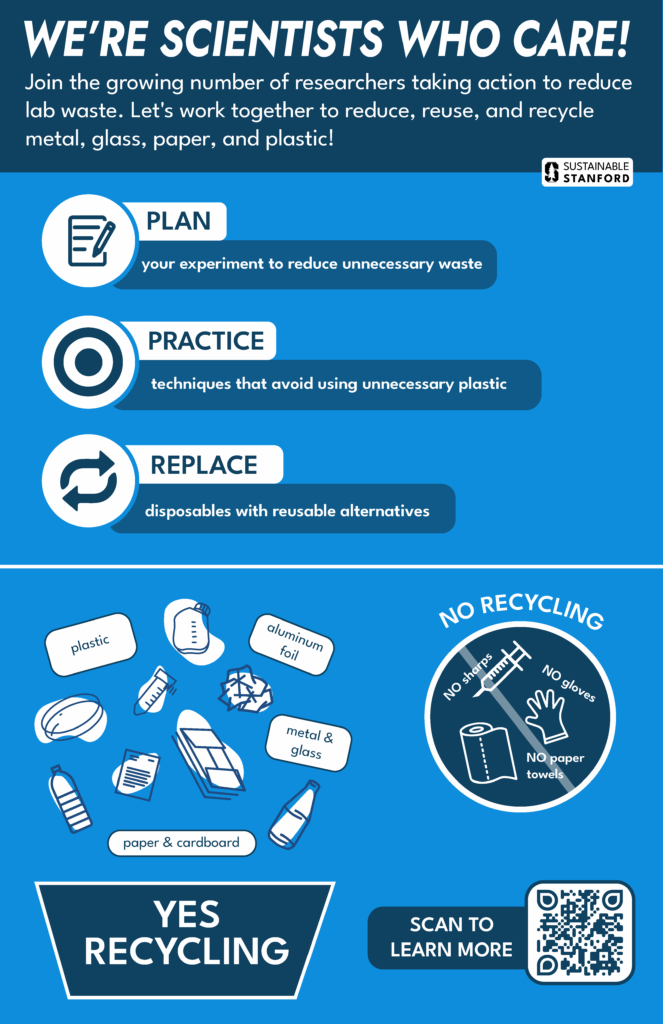
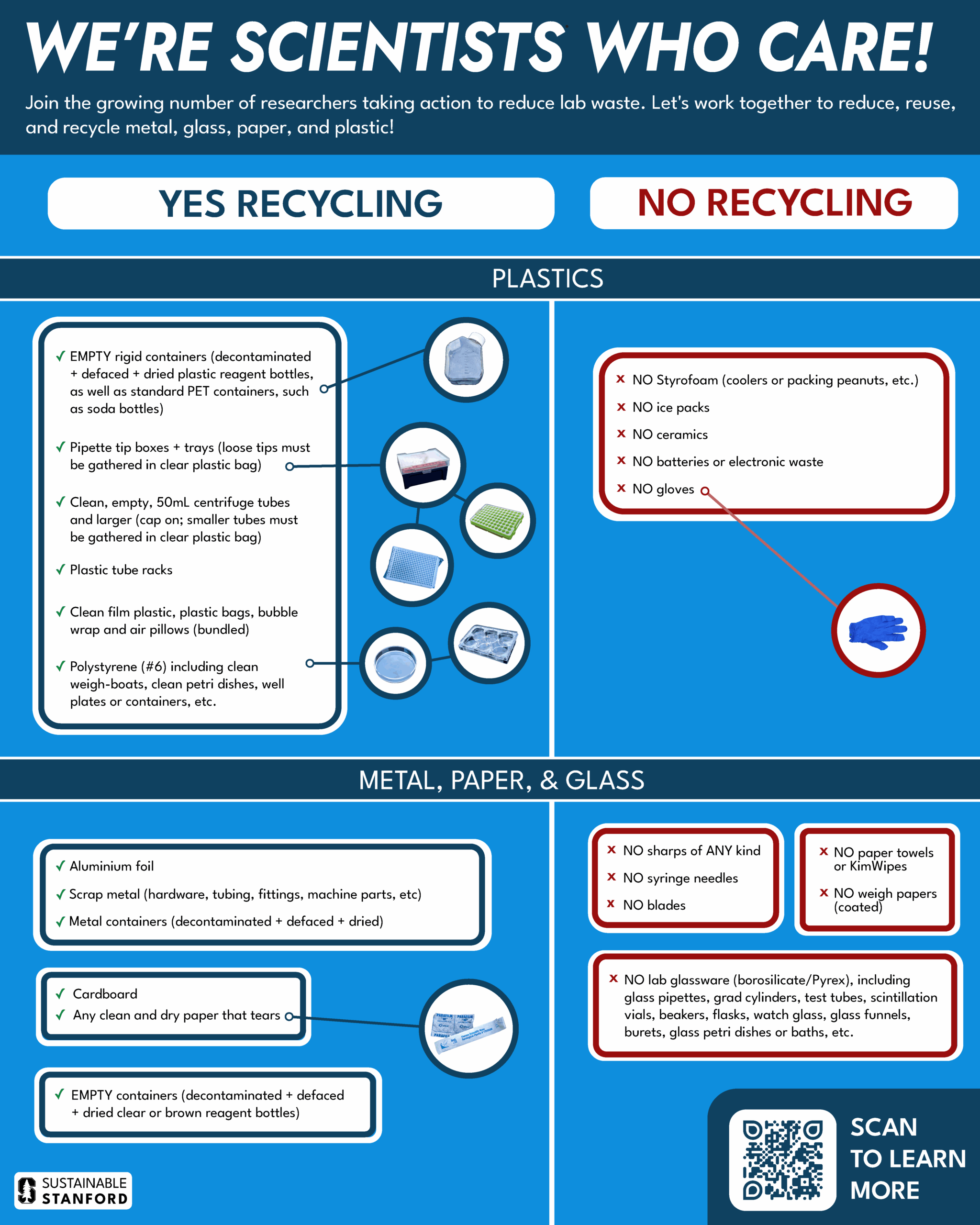
Need additional recycling bins in your lab? Have a unique item in your lab that you’re unsure about recycling?

How one campus building manager is rethinking the supplies behind scientific discovery –helping labs be more circular.
There is no excerpt because this is a protected post.
There is no excerpt because this is a protected post.