
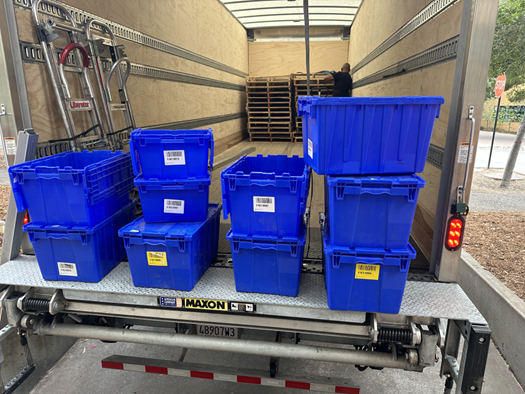
Same Supplies, Better Box: Closing the Loop on Campus Shipping
How one campus building manager is rethinking the supplies behind scientific discovery –helping labs be more circular.
The campus electric load is forecasted to exceed 80% capacity each day this week. Please reduce electricity from 2 to 6 p.m. this week to protect our overall campus power supply. (sustainable.stanford.edu/power-smart)

Few are more mindful of the reality that waste is a modern construct than the Stanford Field Conservation Facility, managed by campus archaeologist Laura Jones. The work of Jones’ team has led them to uncover the historical legacy of environmental practices in the area.
At the turn of the 19th century, Stanford was borne largely of the labor of Chinese immigrants, whose significant contributions to the very existence of Stanford University often go unnoticed or forgotten. The laborers lived on campus in a temporary wooden camp. Under the supervision of Jones, Lauren Conway, Heritage Program Coordinator, and Garrett Trask, Archaeological Field Supervisor, have dedicated their time to investigating and cataloging the cultural resources of Stanford University, such as the artifacts unearthed where the labor camp once stood.
For the laborers, Conway and Trask share that practicing waste reduction wasn’t really a choice. The laborers lived frugally, following an ethos of repair and repurposing what today we might see as trash. “They didn’t have a lot to work with – their waste decisions were dictated by the constraints of their lifestyle and pay.” In this era of convenience at our fingertips: relearning how to live life more mindfully, repairing our clothing and “squeezing every bit of life” out of what we have is a good practice.
The Field Conservation Facility follows similar principles – as Trask explains, they often sacrifice aesthetics and uniformity in favor of reuse and utility. “I think a lot of people don’t feel empowered to make those decisions,” Trask shares, “but we have found that furniture reuse is extremely cost effective.” Conway agrees – “That’s our personal philosophy as a department. If we can avoid putting stuff in landfill, we will.” All of the furniture in the Field Conservation Facility is repurposed, salvaged by Conway and Trask from buildings slated for demolition. The only cost of their effort is time and physical labor, which Conway and Trask emphasize are not something everyone possesses. “We are physically able to do the extra work,” Conway reflects. “Not everyone is able to do that.”
Reuse can be challenging, but to the Field Conservation team, it is worth every minute spent. Conway shared that “We live and work in such a beautiful place. So we’ve got to do the things necessary to take care of it – for the trees, and for every alive thing that depends on this place.”
Build on this legacy, and next time you are in need of something new for your space on campus, search the Stanford Property Reuse Slack channel or peruse the Stanford Reuse website to find your next treasure.
How one campus building manager is rethinking the supplies behind scientific discovery –helping labs be more circular.
There is no excerpt because this is a protected post.
There is no excerpt because this is a protected post.