
Sustainable Research Computing
Academics, Carbon, Community Engagement, Construction & Demolition, Efficiency, Emissions, Maintenance
Danica Sun ’28 explored smarter resource use for one of Stanford’s major computing clusters.
Stanford has committed to achieving net-zero greenhouse gas emissions by 2050 and has already made significant progress reducing Scope 1 and Scope 2 emissions through renewable electricity, efficiency improvements, and the transition of the Central Energy Facility. As these emissions decline, Scope 3 emissions, including construction-related embodied carbon has emerged as the university’s largest remaining sources of emissions. In 2024, embodied carbon from construction projects exceeded Stanford’s combined Scope 1 and Scope 2 emissions. At the same time, California is developing new embodied carbon reporting requirements that will affect many future building projects. This created an opportunity to evaluate how Stanford measures, reports, and manages construction emissions while preparing for a rapidly evolving regulatory landscape.
Stanford currently uses two primary approaches for embodied carbon management. Whole Building Life Cycle Assessments (WBLCAs) provide detailed project-level analysis but historically have been completed after major design decisions have already been made. For annual greenhouse gas reporting, construction emissions are estimated using spend-based methods, which rely on project expenditures rather than material quantities. Both approaches have limitations: one is resource-intensive and often arrives late in the design process, while the other may not accurately reflect project-specific conditions.
The challenge was to identify whether Stanford could improve both reporting accuracy and early-stage decision-making by testing new methods that provide carbon estimates using limited project information. The project also explored how embodied carbon considerations could be better integrated into existing project delivery processes and future regulatory requirements.
A major focus of this project was evaluating C.Scale, a whole-life carbon assessment platform that uses machine learning techniques to estimate building emissions with limited project information. The tool is trained on a large database of industry Whole Building Life Cycle Assessments (WBLCAs) and Environmental Product Declarations (EPDs), allowing it to identify patterns across building types and fill data gaps when detailed material quantities are unavailable. This makes it possible to generate carbon estimates much earlier in the design process than traditional assessments.
To test its applicability at Stanford, eight construction projects were modeled using C.scale’s simplified design workflow, which requires only basic project characteristics that are typically known during early planning stages. Results were compared against available WBLCA studies and existing reporting methods. The evaluation was supported through collaboration with the Office of Sustainability, Department of Project Management, project managers, consultants, and the C.scale team to understand both the technical capabilities of the tool and its potential fit within Stanford’s project delivery process.
The evaluation found that C.scale estimates were generally comparable to completed WBLCAs for the three projects where both datasets were available. Differences ranged from -4.5% to +6.1% when comparing total embodied carbon estimates. In contrast, spend-based emissions estimates differed substantially from project-level estimates across all analyzed projects, ranging from 331% to 3,458% higher. Athletic facility renovations showed some of the largest differences, highlighting the limitations of generalized spend-based approaches for unique project types.
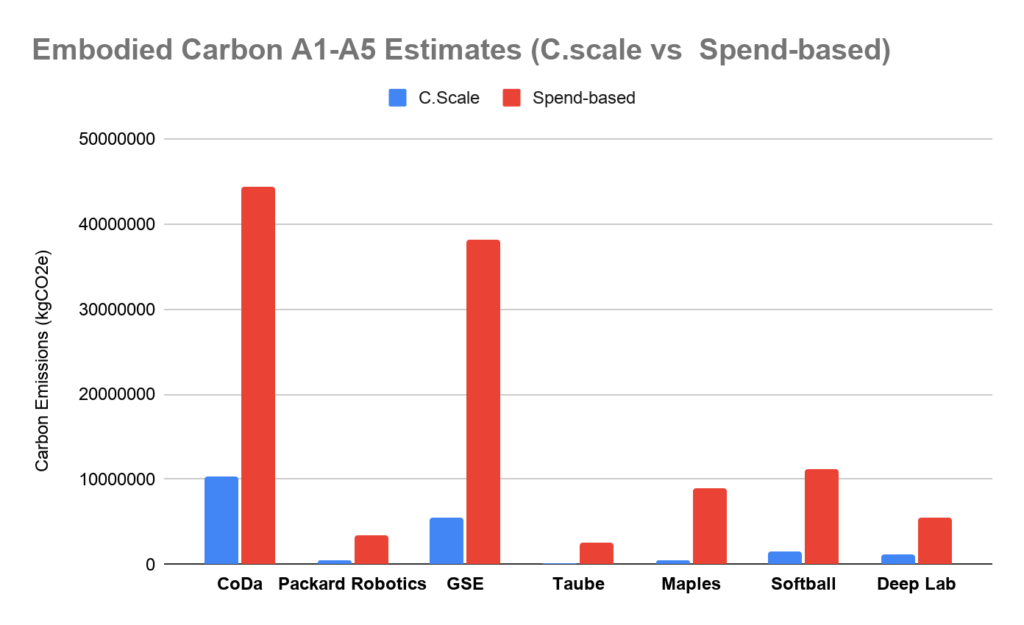
These findings have important implications for long-term carbon accounting and net-zero planning. If embodied carbon were valued at $100 per metric ton of CO₂e, the difference between spend-based reporting and project-level estimates across the analyzed 2025 projects would represent nearly $9 million in avoided carbon liability from using a more representative reporting framework.
One of the most important lessons from this project was that embodied carbon information is most valuable when it is available early enough to influence project decisions. While detailed WBLCAs remain the industry standard, this study demonstrated the potential of machine learning-enabled approaches to significantly reduce the time and cost required to generate carbon estimates, while still providing useful insights for reporting, benchmarking, and early-stage design discussions. The project also reinforced the importance of integrating sustainability considerations into existing project delivery workflows rather than treating them as separate or parallel processes.
From a professional perspective, the fellowship provided experience working at the intersection of sustainability, construction, data analysis, and organizational change. It highlighted the challenges of managing climate-related decisions in environments with limited data, multiple stakeholders, and long feedback cycles, while demonstrating how universities can serve as test beds for innovative approaches that may ultimately scale beyond campus.
Stanford is more comfortable adopting a tool like C.scale for embodied carbon reporting and replacing the current spend-based methodology with a project-based approach that better reflects construction emissions. The next phase of work will focus on further evaluating the C.scale tool across a broader range of project types, particularly projects with completed WBLCAs and detailed material quantity data. This will help determine whether the platform can not only support reporting needs, but also provide reliable early-stage insights that enable design teams to make carbon reduction decisions consistent with those informed by traditional WBLCA studies.
Danica Sun ’28 explored smarter resource use for one of Stanford’s major computing clusters.
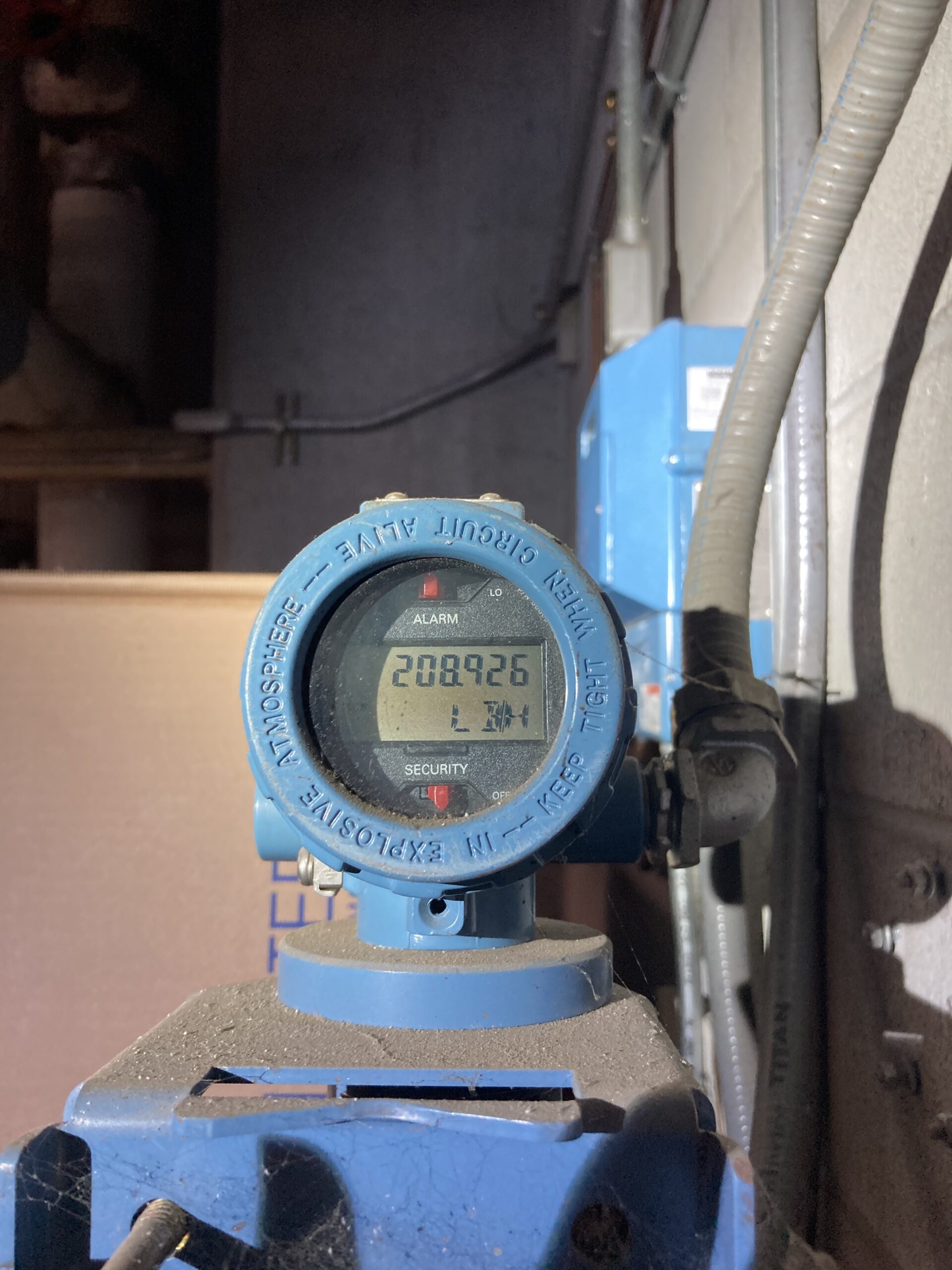
Rachel Porter, PhD candidate, investigated alternatives for reducing reliance on Stanford’s natural gas-fired steam plant.
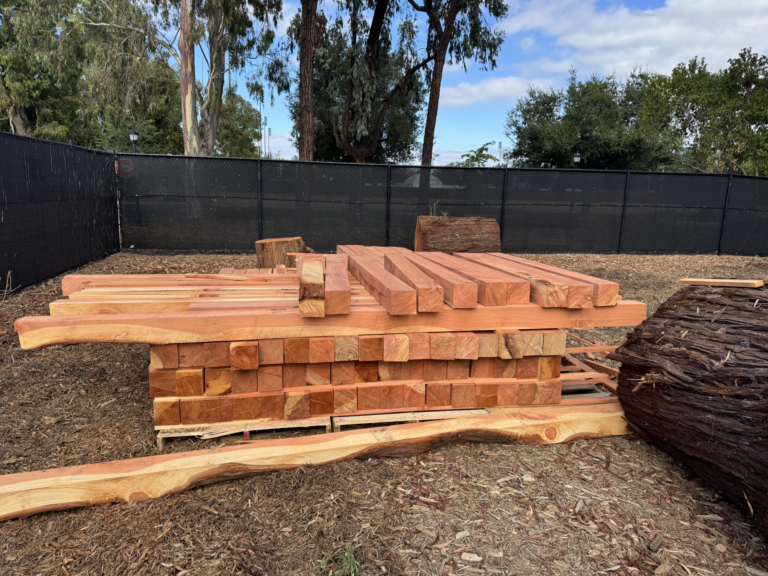
Stanford’s on-site milling program transforms fallen limbs into campus benches and student art–providing the campus community a sustainable alternative to imported lumber.