
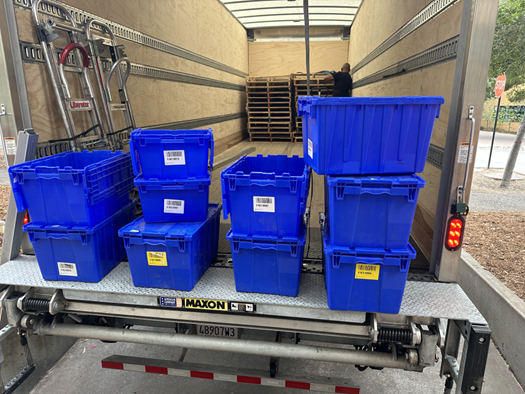
Same Supplies, Better Box: Closing the Loop on Campus Shipping
How one campus building manager is rethinking the supplies behind scientific discovery –helping labs be more circular.
The campus electric load is forecasted to exceed 80% capacity each day this week. Please reduce electricity from 2 to 6 p.m. this week to protect our overall campus power supply. (sustainable.stanford.edu/power-smart)

On Monday, May 5th, over 20 students in Stanford’s Design 1 course shared novel ideas to increase campus recycling and composting rates. Student approaches were inspired by interviews of Stanford staff and students and included everything from AI trash bins to waste art galleries.
At the end of class, students voted on the most feasible and impactful ideas for further consideration by the Office of Sustainability. One finalist from the showcase was an idea to introduce an education requirement during New Student Orientation. Each year, incoming students attend a week-long orientation program guiding themthrough university expectations, campus resources, and pep rallies. Design 1 students voted to include a waste sorting component in this orientation too. “I think if we can facilitate a culture shift towards sustainability as soon as students get here, we can make an impact,” said design student Sofia. Students like Sofia are excited to further develop their ideas and improve campus waste sorting.
“Working with the Office of Sustainability has been such an incredible experience for students,” says Louie Montoya, lead designer and instructor of Design 1.
“The collaboration has allowed us to make learning design feel relevant and impactful because students get to grapple with real world issues and actually contribute to helping solve some of our most pressing challenges.”
This partnership between Design 1 and the Office of Sustainability is a powerful example of how students can help shape a more sustainable Stanford.

How one campus building manager is rethinking the supplies behind scientific discovery –helping labs be more circular.
There is no excerpt because this is a protected post.
There is no excerpt because this is a protected post.