
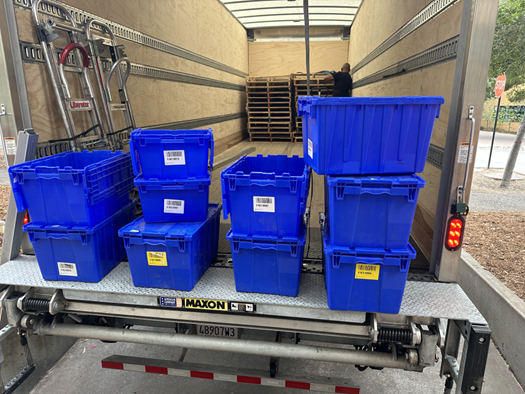
Same Supplies, Better Box: Closing the Loop on Campus Shipping
How one campus building manager is rethinking the supplies behind scientific discovery –helping labs be more circular.
The campus electric load is forecasted to exceed 80% capacity each day this week. Please reduce electricity from 2 to 6 p.m. this week to protect our overall campus power supply. (sustainable.stanford.edu/power-smart)

Can you imagine how much waste a 200,000 square foot medical research building using essential, but single-use, plastics could produce?
Researchers often require extra supplies for their research — pipettes, test tubes, petri dishes, flasks, and moren– to ensure they won’t run out mid-study. However, this can lead to a surplus of unused materials. Linda Heneghan, the Building Manager for Lokey Stem Cell Research and a proponent of reducing lab waste, offers an annual reuse event where students and researchers can exchange their leftover supplies to save them from going to the landfill. Many materials like freezer racks, equipment accessories, and general office supplies find new life and purpose through the reuse event. Not only does it help reduce waste, but it can also save money by avoiding the need to buy new, expensive supplies. A win-win!
Looking for other ways to reduce lab waste?
Witness how fellow students, staff, and faculty are creating a wasteless community, and gain inspiration to implement waste-wise practices in your daily decisions.

How one campus building manager is rethinking the supplies behind scientific discovery –helping labs be more circular.
There is no excerpt because this is a protected post.
There is no excerpt because this is a protected post.