
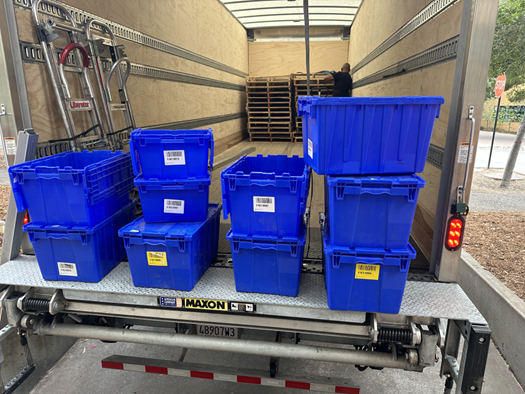
Same Supplies, Better Box: Closing the Loop on Campus Shipping
How one campus building manager is rethinking the supplies behind scientific discovery –helping labs be more circular.
The campus electric load is forecasted to exceed 80% capacity each day this week. Please reduce electricity from 2 to 6 p.m. this week to protect our overall campus power supply. (sustainable.stanford.edu/power-smart)

In 1997, Stanford University and Peninsula Sanitary Service, Inc. (PSSI) invested in an automated sorting machine to separate recyclables to get cleaner material that was more valuable for manufacturers. This enhanced equipment used magnets, jets of air, and other mechanisms to strategically sort out materials by commodity type. Other types of recyclables were sorted by hand by PSSI employees as the material moved along the conveyor belt.
This sorting line processed over 9 million pounds of recyclables. In 2020, the line was decommissioned. Rather than sending it to metal recycling and landfill, Stanford donated the line to a company in McFarland, California where it has been repurposed to help turn food byproducts into animal feed.
Finding a new purpose for this machinery is an example of being a wasteless community. It also helped the wider California community reduce costs and emissions through reuse.
How one campus building manager is rethinking the supplies behind scientific discovery –helping labs be more circular.
There is no excerpt because this is a protected post.
There is no excerpt because this is a protected post.