
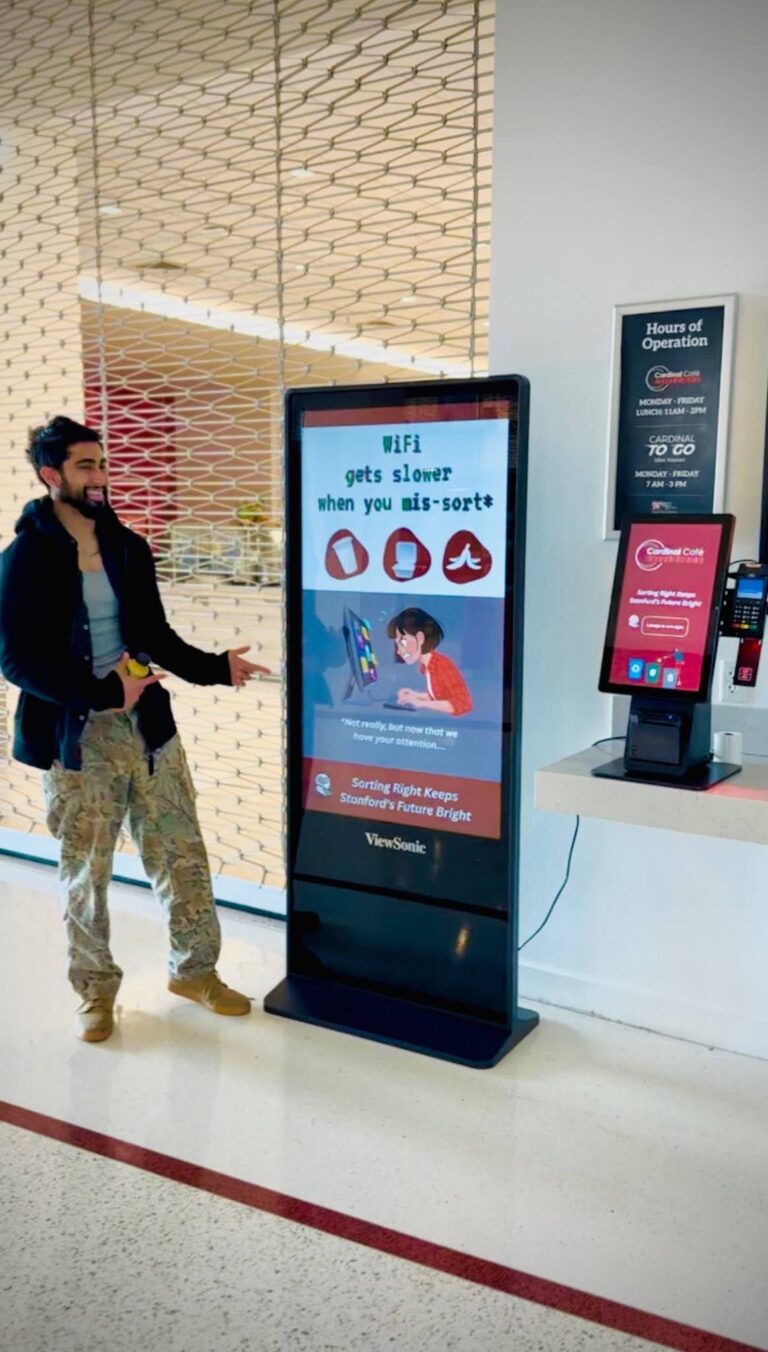
Waste Sorting: The Secret to Faster Wi-Fi Speeds?
Humor-driven signs and a digital pledge cut Cardinal Café sorting mistakes by 10%.

Stanford’s new contract with Peninsula Sanitary Service, Inc. (PSSI) brings new technology — an industry-leading fleet management system that uses cameras and sensors on collection trucks to ensure safe driving practices, monitors equipment to increase efficiencies, and reduces liabilities in real time. Cameras will also be used to record material emptied into the trucks and, with the help of AI, provide critical data on the top contaminants. Contaminants are material that was in the wrong stream; for example, cardboard boxes that were put in the landfill instead of the recycling. Identifying contamination and better understanding what is going in the trucks helps direct outreach and education strategies and programmatic changes, like purchasing strategies, to reduce waste.
Additionally, technology will be used to monitor the capacity of dumpsters to ensure they are right-sized for each building, which can reduce costs, increase efficiencies, and help divert additional material away from the landfill.
Humor-driven signs and a digital pledge cut Cardinal Café sorting mistakes by 10%.

Students are transforming reusable mugs into a community ritual–reducing waste while rebuilding campus culture.

Danica Sun ’28 explored smarter resource use for one of Stanford’s major computing clusters.