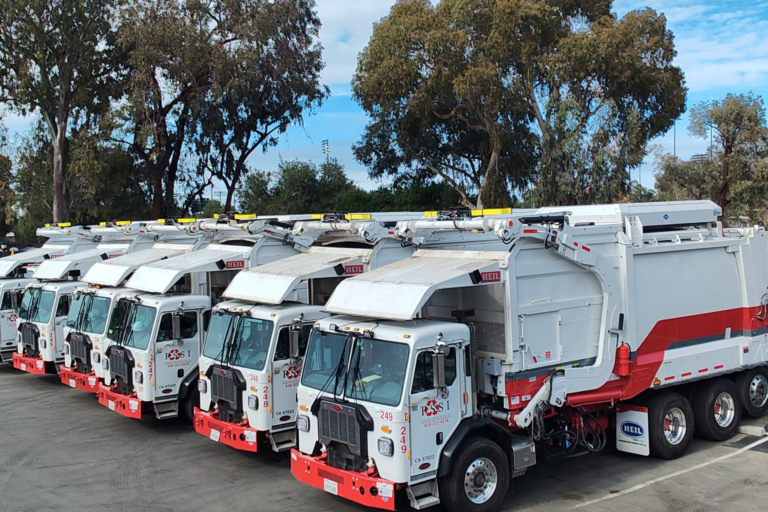
Stanford’s Quiet Leap Towards Sustainable Waste Collection
New campus fueling station makes waste operations more efficient and sustainable.

Laboratories are some of the most energy-intensive spaces on Stanford’s campus. On average, laboratory buildings consume 3-5 times more energy than office buildings. The Office of Sustainability has a number of resources, including rebates, to help you conserve energy and lower equipment emissions like refrigerants.
An easy way to contribute to energy conservation is by shutting the fume hood sash when not in use. When open, a single fume hood can use as much energy as 3.5 homes! If your group is no longer using a specific fume hood, consider having it locked and decommissioned so air no longer flows through it. Order free fume hood sash stickers on the Environmental Health & Safety site to help remind lab personnel of the appropriate fume hood sash height for energy savings and safety.

Laboratory equipment makes up approximately 11% of Stanford’s electricity consumption. Can your lab equipment be turned off during the evenings and weekends?
Use an outlet timer to shut down and start up equipment automatically at set times to help conserve energy. Outlet timers reduce equipment energy consumption up to 50%, resulting in energy cost savings for the lab and department. Timers can also reduce the fire hazard risk of having electrical heating equipment on when no one is in the lab.
If you work in a lab that uses cold storage (e.g., refrigerators or freezers), you are keenly aware these types of equipment consume a significant amount of energy, and the refrigerants used in the equipment can emit harmful greenhouse gases. Did you know that a standard -80 freezer can consume nearly as much energy as a single-family home? There are a number of ways to optimize performance of your cold storage. Get the most out of ultra-low temperature (ULT) freezers by maintaining them properly.

Are you buying a new ultra-low temperature freezer? Rebates are available for choosing energy-efficient models, whether you are replacing an old freezer or purchasing new equipment. All eligible freezer models use refrigerants with relatively low potential for emissions.
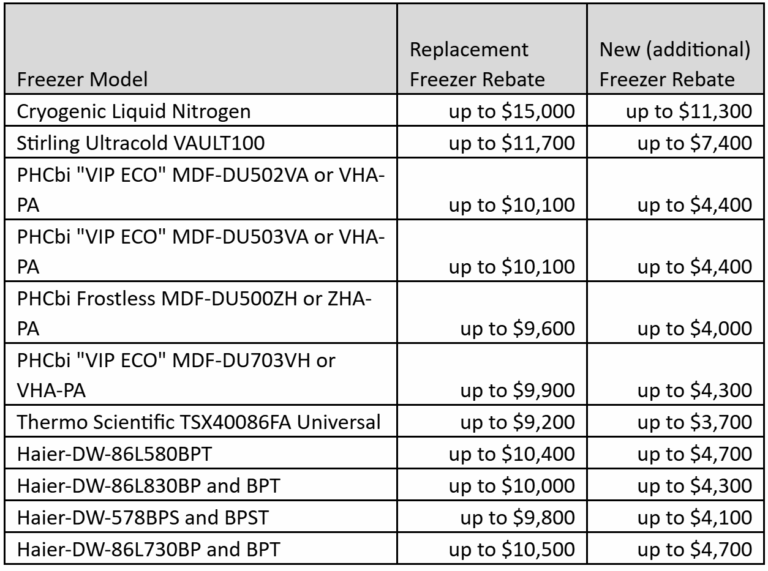
Rebates are only for labs located on Stanford University’s main campus. Please complete and submit the application below by August 15 to receive a rebate for the current fiscal year (September 1 to August 31). Funds are limited and rebates are allocated on a first come, first served basis for each fiscal year. If this form is open, then funding is still available for the year. Email for questions.
You can receive a full rebate for room temperature storage starter kits. Biological samples that are typically stored frozen can be stored at room temperature using a proprietary stabilization technology that Stanford developed in 2009. Contact Michael Huang for more information.
Rebates can also be provided for other types of lab equipment, such as incubators and lasers, if proven energy-efficient models are purchased. Contact Michael Huang to initiate the process.
New campus fueling station makes waste operations more efficient and sustainable.

The School of Medicine turns smart energy projects into lasting savings, with the help of energy rebates offered through Stanford’s Facilities Energy Management team, leading to over $2.7 million in annual savings for the university.

The SESI program transformed the university’s energy system into one that’s safe, sustainable, and resilient and serves as a model for the world.