
Protected: Measuring Emissions from Purchased Goods & Services
There is no excerpt because this is a protected post.
The campus electric load is forecasted to exceed 80% capacity each day this week. Please reduce electricity from 2 to 6 p.m. this week to protect our overall campus power supply. (sustainable.stanford.edu/power-smart)

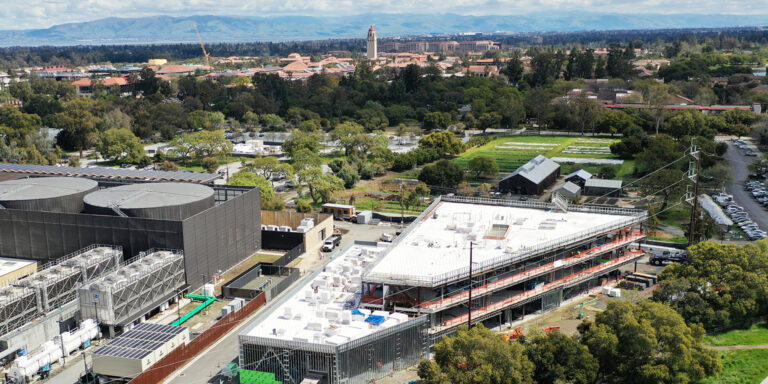
When much of the energy industry was focused on refining fossil fuel-based systems in the early 2010s, Stanford took a bold step forward by reimagining the system entirely. The result is the Stanford Energy System Innovations (SESI) project, which brought the highly efficient Central Energy Facility into operation in 2015 and transformed the university’s energy system into one powered predominantly by 100% renewable electricity, provided through the production of two Stanford solar generating stations and grid direct access.
We envisioned building a low-carbon energy system designed from the ground up for the 21st century, with the ultimate goal of being powered predominantly by renewable energy,” said Jack Cleary, associate vice president for academic projects and operations within Land, Buildings, and Real Estate (LBRE). “And today, we are proud to say that vision has been achieved.”
On April 3rd, 2025, an estimated 300 guests gathered at the Central Energy Facility on the west side of campus to celebrate the 10th anniversary of Stanford Energy System Innovations. Cleary emceed the event, which was organized by Stanford’s Office of Sustainability in coordination with the Energy Operations team. It included campus leaders closely involved with the project, who remarked on the success of the program, as well as state and local government leaders who shared their congratulations.
There is no excerpt because this is a protected post.
There is no excerpt because this is a protected post.
Ponsu Muthuraman ’26 evaluated the use of a machine learning tool to improve construction carbon emission estimation.