Transportation

Over 85% of students and approximately 30% of employees commute to Stanford sustainably

Transportation emissions result primarily from student and employee commuting and account for approximately 2% of Stanford’s Scope 3 emissions. In response, Stanford focuses on reducing single-occupancy vehicle travel by strengthening regional transit connections and expanding access to low-emission travel options. 

Student commute patterns show the highest sustainable mode share, with 47.31% commuting by bicycle and only 12.29% driving alone. Among employees, Caltrain and bus transit continues to grow while 44.90% of employees commute by personal vehicle. Additionally, 24.8% of employees telecommute. 

Stanford’s Platinum-level Bicycle Friendly University recognition reflects sustained support for connected cycling networks, secure bicycle parking, and commuter programs. These efforts have reduced drive-alone rates and increased the share of trips made by low-carbon modes.

Remaining challenges include closing gaps in electric vehicle charging and bicycle infrastructure and supporting longer-distance commuters. Continued coordination with regional agencies and community partners will be critical to scaling equitable, low-emission transportation options.

Stanford operates free zero-emissions Marguerite bus services connecting campus to transit hubs, neighborhoods, and key destinations, including routes aligned with regional rail service. Real-time tracking tools and transit information improve reliability and rider experience. Charter and community shuttles further reduce individual vehicle trips for events and airport travel.

Mitigation
ongoing

Stanford provides personalized commute planning services to help students, faculty, and staff shift to lower-emission travel options. One-on-one consultations, commute toolkits, and carbon and cost calculators support informed choices across transit, biking, carpooling, and walking. These services reduce single-occupancy vehicle travel by making sustainable commuting options easier to understand and adopt.

Mitigation
ongoing

Stanford provides university employees, postdoctoral scholars, and graduate students with free, unlimited travel on local public transit including Caltrain, VTA, and AC Transit. The university also offers commuter rewards and incentive programs such as pretax commuter benefits to  reduce single-occupancy vehicle travel and associated emissions..

Mitigation
ongoing

Stanford’s vanpool and carpool programs reduce single-occupancy vehicle trips. Vanpools offer incentives such as free insurance, vehicle maintenance, and reduced bridge tolls. With plans to expand vanpool funding and increase carpool participation, these programs support regional access to campus while lowering transportation-related emissions.

Mitigation
ongoing

Cars for short-term rental are available at dozens of locations around the Stanford campus. These services reduce the need for personal vehicle ownership, support occasional travel needs, and complement transit, biking, and walking for low-emission campus access.

Mitigation
ongoing

Stanford’s nationally recognized bicycle program—awarded Platinum Level status by the League of American Bicyclists four times—supports zero-emission commuting through safe, efficient infrastructure and amenities. Stanford offers bike safety and maintenance education, bike parking, bike circles, bike lanes, multi-modal paths, and bike cages across campus, and has piloted the development of protected bike lanes. These investments have resulted in over 10,400 bicycles on campus daily, reducing transportation-related emissions.

Mitigation
ongoing

Stanford’s disability golf cart service, known around campus as DisGo, provides complimentary, year-round, accessible curb-to-curb transportation between core campus locations for students, staff, and faculty members with disabilities or medical conditions. By using electric carts, the program improves air quality and reduces localized emissions while enhancing equitable access to campus buildings.

Mitigation
ongoing

Stanford is expanding EV charging for commuters, residents, and visitors with electric vehicles. Stanford is also researching opportunities to integrate microgrids with the EV charging infrastructure by combining renewable energy sources, energy storage systems, and advanced controllers to improve grid resilience.

Mitigation
planning

Stanford has implemented six traditional intersections into roundabouts and plans to convert four more, which saves fuel, reduces emissions, and improves safety for cyclists and pedestrians. Each roundabout is expected to save 24,000 gallons of gas per year and cut CO₂ emissions by up to 46%.

Mitigation
ongoing

Stanford plans to develop transportation outreach information in multiple languages and cultural contexts to support equitable access to transit information for non-English-speaking populations, including marginalized groups with high rates of linguistic isolation.

Mitigation
planned

Stanford engages the campus community through annual commuter surveys, Bike to Work Day events, and targeted outreach to promote low-emission commuting and track travel behavior. These insights inform community-centered transportation planning that identifies barriers, prioritizes inclusive design improvements, and expands equitable access to sustainable transportation options across campus.

Mitigation
Resilience
ongoing

 Telecommuting reduces commute emissions; additionally, remote work and virtual classrooms can accommodate campus users in many cases if major disruptions to transportation occur (e.g., hybrid work arrangements, hybrid meeting technology, Cardinal Flex Workspace system).

Mitigation
Resilience
ongoing

Taking the Wheel: Students Steer the Vision for Enhanced Campus Mobility
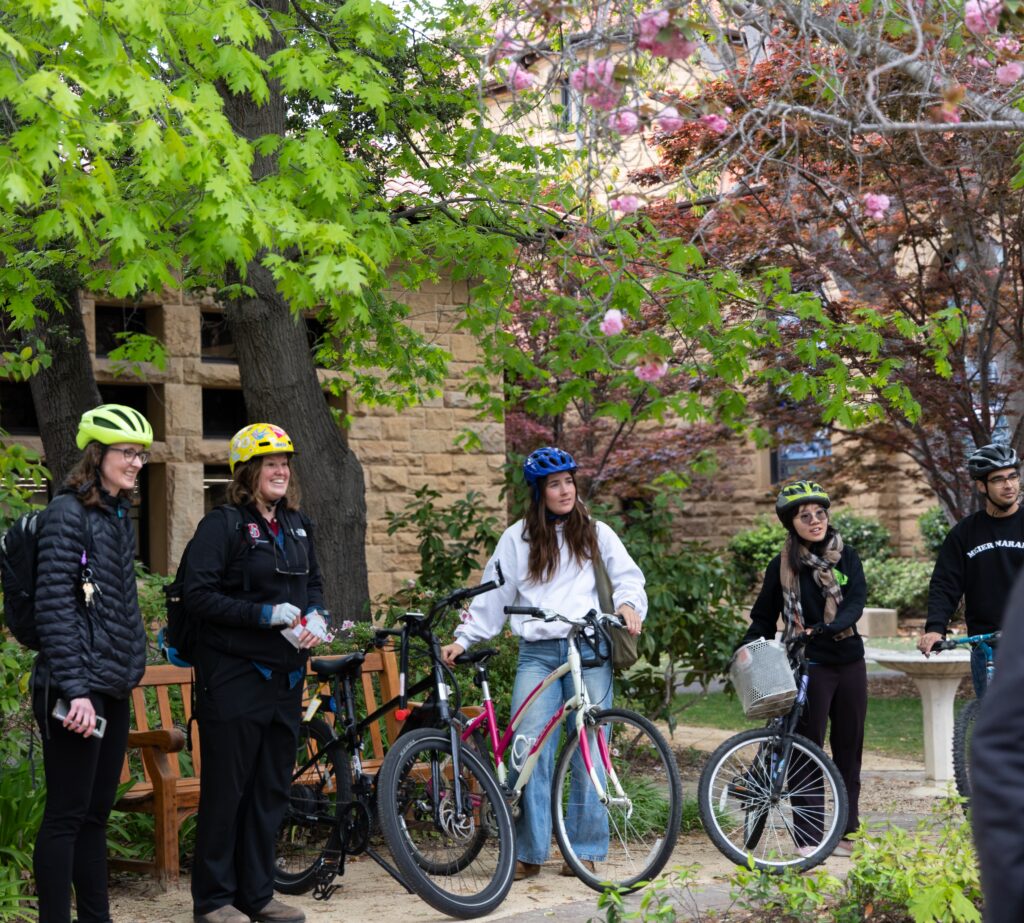
Stanford is home to thousands of students who navigate campus daily and who have invaluable insights on the routes to where they live, work, learn, and play.

Students play a critical role in transforming campus mobility, shaping the culture with their choice of transportation mode and active participation in sustainable commute programs. An immensely popular 2025 focus group for students asked participants for feedback on the efficiency of Marguerite buses, developments for future biking infrastructure and bike-sharing programs, and better solutions to improve communication about transportation options.

Focus groups not only empower students to voice their perspectives but also sets the stage for a more sustainable and bike-friendly campus. Together, students are leading the charge toward the next era of transportation planning at Stanford.