Land Use & Planning

Stanford’s campus spans over 8,300 acres of academic, residential, research, and natural lands. Land use decisions shape emissions, energy demand, and climate resilience.

The university’s choices about where to build, how to conserve essential open space, and how to adapt to climate risks directly influence operational energy demand, mobility patterns, and protection of ecosystems that sequester carbon, manage stormwater, moderate heat, and reduce climate risk. As climate change brings higher temperatures, variable rainfall, and more frequent extreme events, land use planning must reduce emissions, support a resilient campus, and ensure the university can continue to fulfill its academic and research mission.

Stanford has advanced adaptation by restoring habitats through its Conservation Program, expanding green infrastructure, strengthening flood and stormwater systems, reducing wildfire risk through vegetation management, and improving community preparedness through cooling centers and emergency response capacity. Operational investments in energy reliability and backup power planning also support continuity during climate hazards affecting both on-campus and off-campus assets.

Stanford’s climate vulnerability assessment established a baseline for land-related risks across facilities and natural systems, then prioritized climate impact challenges, such as heat, drought, flooding, and wildfires, in comparison with policy development,  balancing growth, and asset protection.  Building on Stanford’s current climate adaptation successes, this assessment highlighted opportunities to strengthen land use policies, scale green infrastructure, protect key habitats, and optimize land stewardship for resilience. These findings now guide climate-informed planning to reduce operational risk and support the university’s long-term sustainability goals.

Stanford will supplement its current land use practices to further offset specific climate hazards such as flooding, heat, and wildfire. The updated practices will guide new development away from high-risk areas and/or implement appropriate mitigation measures, incorporating nature-based solutions and conservation priorities.

Resilience
planned

Stanford will assess its existing land holdings to identify underused sites for redevelopment or adaptive reuse. The university will focus on compact growth, co-locating new development with transit and energy infrastructure, and retrofitting facilities for resilience to heat and smoke.

Resilience
planned

New buildings, renovations, and any new space requests on Stanford’s main campus are reviewed and approved by the Provost’s office. These requests must demonstrate compliance with the Cardinal Space guidelines, which focus on optimizing the use of existing administrative space and reducing building energy needs. The guidelines align workspace allocation with in-person, hybrid, and remote work arrangements, promoting more shared and communal work spaces. Widespread adoption of the guidelines is expected to avoid missions of 25,000 MTCO2e over 15 years, save $500 million in capital costs, and $8.5 million in operational costs annually.

Mitigation
Resilience
ongoing

This plan focuses on the establishment of regular tree risk inspections, prioritization of pruning and cabling over removal, and replacement of non-native trees with climate-adapted native species. These actions will help manage, mitigate, and minimize risk to the university’s primary assets: people, academic buildings, and infrastructure. In addition, the Plan seeks to maintain and grow the campus canopy to further support climate resilience.

Resilience
Mitigation
ongoing

Stanford maintains and expands vegetation management practices, including thinning, pile burning, and managed grazing, to reduce hazardous fuel loads. These efforts are coordinated with regional partners to manage risks across shared landscapes and the wildland-urban interface.

Resilience
Mitigation
ongoing

Strategies such as bioswales, rain gardens, and tree canopy to manage stormwater will support Stanford in reducing urban heat, and support biodiversity across both new and existing campus areas.

Resilience
planned

Landscaping and restoration efforts prioritize native and climate-adapted plant species while actively managing invasive species. These practices reduce water demand and support long-term ecosystem resilience through the Conservation Program.

Resilience
ongoing

Restoration and maintenance of native vegetation along campus streams and rivers protects water quality, reduces erosion, and provides habitat for wildlife, building on current efforts in the Conservation Program.

Resilience
ongoing

Habitat connectivity efforts identify and protect wildlife corridors and buffer zones to support species movement and reduce fragmentation. These efforts are coordinated with regional partners and expand on existing conservation work.

Resilience
ongoing

Emergency preparedness planning includes identifying and equipping sites to store and distribute essential resources, such as masks, air filters, water, and medical supplies, during climate-related events.

Resilience
ongoing

Transportation and land use strategies improve transit, bicycle, and pedestrian networks while co-locating housing and services near these systems. These efforts reduce vehicle miles traveled and maintain access during climate-related disruptions.

Resilience
Mitigation
planned

Agricultural land management practices integrate water-efficient irrigation, native vegetation, integrated pest management, and protections for workers during heat and smoke events through coordination with leaseholders.

Resilience
planned

A Blueprint for Balance: Scaling Stanford’s Mission & Sustainability
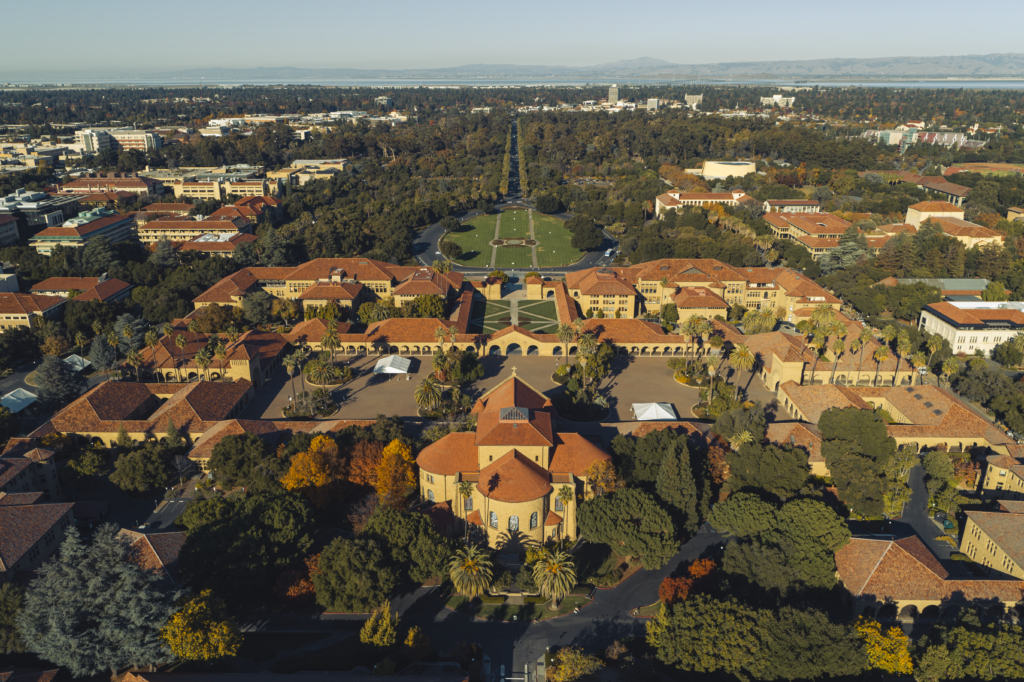
StanfordNext is the university’s long-term plan designed to meet future academic, housing, transportation, sustainability, and infrastructure needs on existing campus lands. The plan will inform the application for a new General Use Permit (GUP), which is the regulatory framework that would authorize Stanford’s future advancements. StanfordNext supports land use decisions that prioritize compact development, housing near academic and transit centers, expanded biking and transit infrastructure, and long-term protection of conservation areas. Currently, this planning effort is in its early development stages and will be informed by ongoing community engagement channels such as open houses, advisory and focus groups, polls, and surveys.

Since 2000, Stanford has expanded its academic and research footprint on campus while cutting Scope 1 and 2 emissions by 82%, reducing vehicle trips and demonstrating that Stanford can create new academic space and build commensurate housing while reducing its emissions. Planning how and where Stanford supports new academic space is central to this plan and to reducing emissions and strengthening long-term climate resilience. The aim is to ensure key land use goals included in StanfordNext lower transportation demand, protect climate-sensitive landscapes, and guide future academic space in alignment with Stanford’s Climate Action Plan and resilience goals.