Grounds Operations

Over 37,000 trees with 32% canopy coverage and 52%+ electric grounds equipment support campus cooling, air quality, and climate resilience

Stanford manages its landscapes with long-term reliability and ecological stewardship, building on Frederick Law Olmsted’s original principles for climate-appropriate, low-water plantings and cohesive campus design. The university is refining its future plant palette so landscapes can perform well under warmer, drier conditions while sustaining habitat value and campus character.

Grounds operations account for less than 1% of Stanford’s Scope 1 mobile emissions from gasoline-powered equipment, but they play a critical role in advancing climate adaptation and environmental stewardship. Initiatives such as smart irrigation systems, integrated pest management, organic landscape pilots, and the transition to electric equipment demonstrate how sustainable grounds practices can reduce emissions, conserve water, and improve ecosystem health. These efforts ensure Stanford’s landscapes remain climate-ready, low-impact, and biodiverse as the campus continues to evolve.

The majority of Stanford’s landscapes are irrigated with non-potable lake water. Systems are in place to direct water as it flows through campus to holding areas, then capture excess water and pump it back into the lake water system, maximizing landscape water conservation.

Resilience
ongoing

Grounds are designed using climate-resilient plant palettes for landscaping and monitoring species performance over time. Approximately 75% of the campus uses native or drought-resilient plantings with mulch or non-irrigated grass and native oaks for canopy.

Resilience
ongoing

Stanford’s Arboretum Vegetation Master Plan outlines a long-term strategy to restore and enhance the 220-acre Arboretum as a climate-resilient, biodiverse, and culturally significant open space. The plan defines six vegetation communities, integrates climate-forward planting, supports stormwater management, and enhances habitat, access, and cultural programming.

Resilience
Mitigation
in-progress

Stanford’s climate-forward planting initiative is transforming its Arboretum with vegetation selected from a 30-year study on tree species resilient to warming conditions. By prioritizing drought-tolerant oaks with deep roots and symbiotic fungal networks that enhance water uptake and carbon sequestration, the project not only restores canopy lost to development but also strengthens ecological resilience and honors Indigenous land stewardship practices.

Resilience
Mitigation
ongoing

Stanford employs smart irrigation systems that automatically adjust based on rainfall and humidity to conserve water while maintaining healthy landscapes. The pilot program that informed the university’s irrigation systems showed a 26% reduction in water use, which translates to almost 2 million gallons saved annually.

Resilience
Mitigation
ongoing

Stanford converted the football stadium subsoil to sand. This enhances field drainage and aeration, leading to a greater rooting depth and more efficient watering, improving the health and resilience to the field.

Resilience
Mitigation
completed

Stanford is committed to maintaining recreational campus turf to support a wide range of activities. These green spaces help reduce local temperatures, and when weather permits, university departments and campus groups are encouraged to use outdoor turf for programs and events instead of indoor venues to maximize campus space and minimize use of building system resources.

Resilience
ongoing

Stanford aims to transition all groundskeeping tools to battery-powered alternatives as gas-powered equipment reaches its end of life and alternatives become available. This includes backpack leaf blowers, hedge and line trimmers, chainsaws, and mowers.

Mitigation
in-progress

Stanford is assessing electrical capacity and infrastructure needs to support the transition to electric grounds equipment across campus. New and renovated corporation yards will include maximum capacity for charging electric equipment along with innovative power management strategies, including control of charging schedules, energy storage, etc.

Mitigation
in-progress

Stanford upgraded most exterior campus lighting to LEDs between 2015 and 2018. The first phase retrofitted road and pathway lighting, cutting electricity use by roughly 50%. The second phase converted building exteriors, stairways, and decorative fixtures to LEDs while maintaining lighting quality. Combined upgrades save approximately 1.2–1.3 million kWh annually.

Mitigation
in-progress

A campus-wide Integrated Pest Management (IPM) initiative unites students, staff, and departments to develop environmentally sound pest control strategies. Building on Stanford’s existing IPM program—which prioritizes minimal pesticide use, protection of non-target organisms, and long-term plant health—the project will compile best practices, institutional knowledge, and stakeholder input to establish best-in-class IPM standard operating procedures.

Resilience
in-progress

Stanford maintains a GIS-based tree inventory system to track the health, species composition, and condition of more than 37,000 trees across campus, which provide the campus with an average 32% canopy coverage. The inventory shows that native species make up 43% of Stanford’s trees, with the Coast Live Oak as the most common species, representing about 30% of all campus trees.

Resilience
Mitigation
in-progress

Stanford monitors trees across campus for irrigation outage detection and tree health assessments using compact sensors installed into select trees. The monitors have assisted Stanford in maintaining the health and resilience of university trees.

Resilience
Mitigation
ongoing

Stanford’s tree relocation program works to relocate trees of semi-mature size that would otherwise be demolished when in conflict with construction projects. This preserves the campus’s existing ecosystems and carbon sinks. Approximately 1,500 trees have been transplanted over the last 30 years.

Mitigation
ongoing

The Campus Canopy Proposal establishes a framework to maintain and enhance Stanford’s campus tree canopy, which is currently estimated at 32% of total land area. The proposal outlines a university-wide approach to replanting and long-term tree stewardship that ensures canopy continuity amid development and climate change. It emphasizes flexible tree replacement across campus, prioritizes climate-resilient species, and minimizes the risks of a monoculture.

Resilience
Mitigation
in-progress

When possible, felled trees are repurposed as materials for campus furniture such as outdoor benches; used as lumber for repairs, fencing, etc.; or left in place to support habitat creation and biodiversity.

Resilience
Mitigation
ongoing

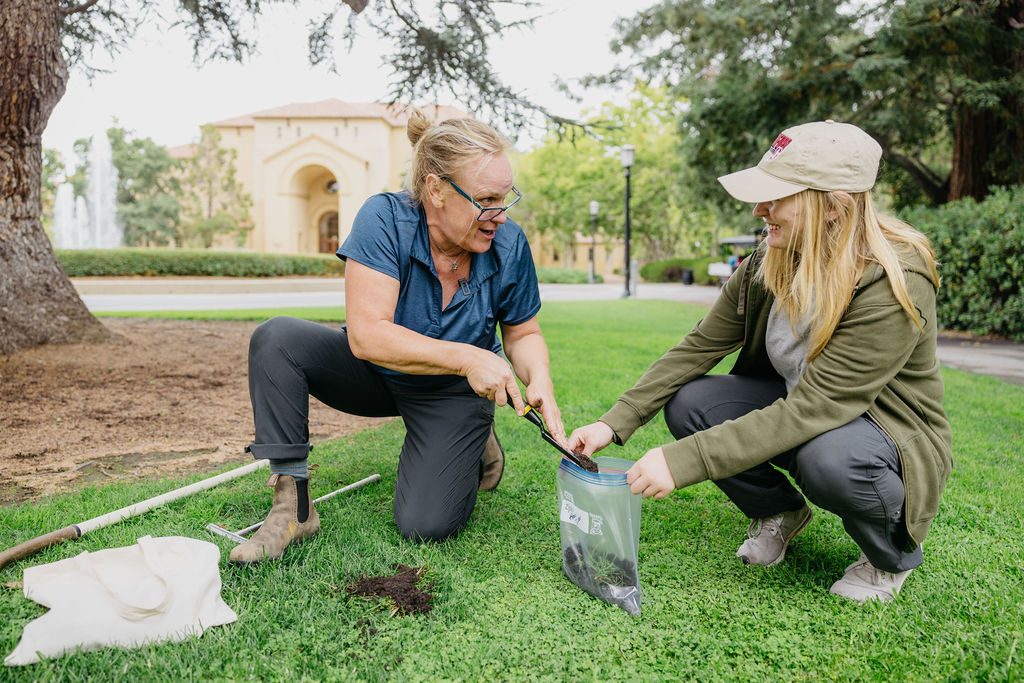
Organic Landscape Pilot

Stanford is advancing sustainable landscape practices by piloting organic land management strategies across select campus sites. These pilots aim to reduce reliance on synthetic pesticides and herbicides, improve soil and ecosystem health, and enhance human and environmental safety.

These strategies are part of a broader effort to document existing practices, build cross-departmental partnerships, and evaluate scalable approaches to organic land care. The pilot program leverages external expertise and student engagement to position Stanford as a living laboratory for sustainable groundskeeping and serves as a model for reducing chemical inputs while maintaining high-performance landscapes.