Fleet

Over 1000 fleet vehicles, with a majority already zero-emissions vehicles

Stanford’s fleet includes buses, trucks, carts, tractors, and specialized equipment. Fleet emissions, produced through fossil fuel combustion in university-owned vehicles, account for approximately 4% of Stanford’s Scope 1 and 2 emissions. More than half of the fleet is already zero-emission, with the electric bus fleet supported by a dedicated charging facility and other vehicles served through a growing, decentralized network of charging infrastructure.

Transitioning the remaining fleet requires addressing higher upfront costs, vehicle customization needs, and expanded charging capacity across campus. Stanford is advancing this work through clear procurement standards, phased infrastructure expansion, and cross-departmental coordination. These efforts reduce direct emissions while supporting broader campus electrification and strengthening long-term resilience.

Stanford’s Marguerite shuttle fleet includes 41 all-electric buses, providing free, year-round service that connects campus to regional transit, shopping, and neighborhoods. Riders can track buses in real time via the Marguerite app live map, increasing usability. Approximately 90% of annual shuttle miles are powered by electric vehicles, reducing 1315 MTCO₂e annually compared to diesel-powered fleets.

Mitigation
ongoing

To support the electrification of Stanford’s fleet and charging infrastructure expansion, the university commissioned a study to evaluate current fleet assets, electrical capacity and parking needs across lots where fleet vehicles are parked, and the need for fast-charging opportunities. The results of the study inform Stanford’s strategic plan for fleet electrification and EV charging solutions for broader campus needs.

Mitigation
completed

Stanford is expanding fleet charging infrastructure across the campus to support departments in purchasing electric vehicles. Centralized fast chargers are being considered as part of this expansion, which will enable further electrification of the Stanford fleet vehicles.

Mitigation
planned

Stanford is exploring the installation of telematics on all university vehicles to track real-time utilization. This data will identify underused vehicles, support right-sizing of departmental fleets, and reduce future vehicle purchases. A smaller, more efficient fleet will lower lifecycle emissions, decrease operating costs, and streamline the transition to zero-emission vehicles.

Mitigation
in-progress

Stanford works directly with manufacturers to design and procure electric vehicles that meet operational needs for maintenance, transport, and grounds work. This ensures electric models can replace specialized equipment and supports full fleet electrification across diverse use cases.

Mitigation
ongoing

Stanford is assessing opportunities for vehicle-grid integration (VGI) with the university’s fleet to expand campus energy storage, provide cleaner peak-energy sources, and increase resiliency. VGI harnesses unused energy from electric vehicles, using fleet vehicles as distributed energy resources to support both operational demands and grid stability.

Mitigation
Resilience
planned

Stanford is exploring AI-powered software solutions for predictive charging management, aiming to forecast EV charging demand and optimize grid load balancing. This strategy supports efficient use of campus energy resources as the demand for campus charging increases.

Mitigation
Resilience
planned

Custom Electric Truck Slashes Emissions Directly at the Source
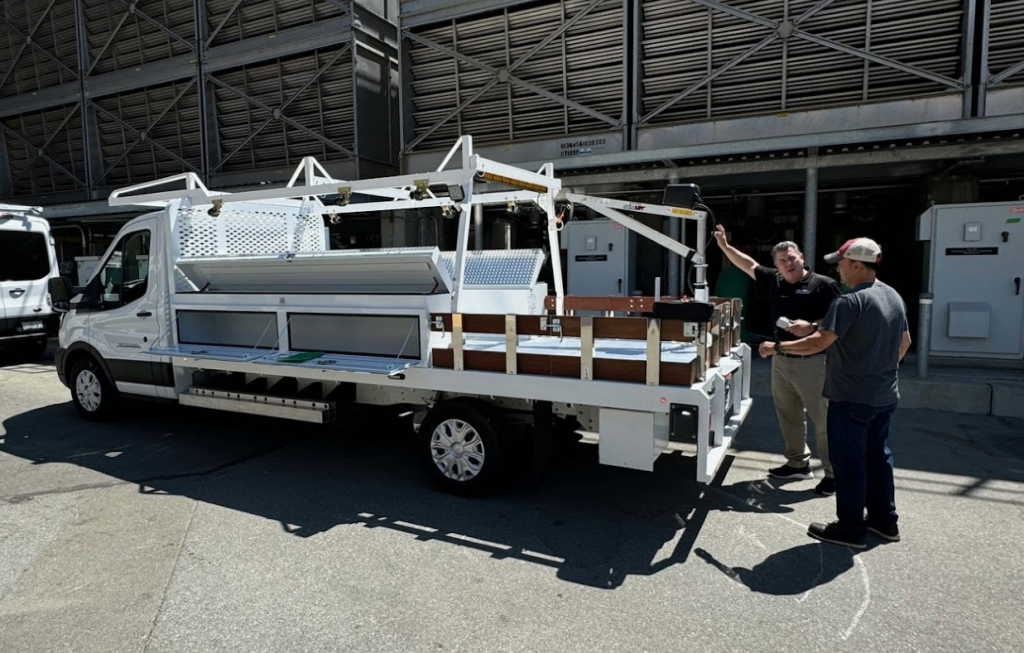
Stanford Energy Operations wanted an all-electric service vehicle with specialized capabilities that major manufacturers could not offer. Instead of waiting for the market to catch up, the department staff built it themselves. The electric truck replaces a gas-powered model—cutting high-impact pollutants directly at the source—and tailors electric solutions for real-world operational needs.