
Leased Property
Over 21 million square feet of Stanford-owned space is leased to hundreds of third parties, including 150 companies at Stanford Research Park and 140+ retail tenants at Stanford Shopping Center
Leased assets span a wide variety of property types, including hotels, medical and commercial office buildings, apartments, retail buildings, single-family homes, and agricultural lands and account for an estimated 14% of Stanford’s overall Scope 3 emissions footprint. Emissions primarily reflect energy use in buildings where Stanford owns the land or facilities but does not control day-to-day operations, including portions of the Stanford Health Care campus, Stanford Medicine Children’s Health facilities, the SLAC National Accelerator Laboratory, and faculty and staff housing.
Where Stanford has direct operational control, Stanford advances emissions reductions and climate resilience through building system upgrades; electrification planning for gas-using equipment, where feasible; drought-resistant landscaping; energy-efficient lighting; and transportation demand management initiatives. All of these efforts include programs at Stanford Research Park. Stanford has also launched targeted efforts to support home electrification for faculty and staff who own homes on campus.
For properties outside Stanford’s downstream leases, the university focuses on enabling and influencing emissions reductions through tenant engagement, education, and collaboration. Limited data access, diverse property types, and shared governance structures pose challenges for tracking and implementation. Stanford is addressing these barriers through expanded outreach with lessees, targeted programs, and partnerships that support progress on Scope 3 emissions associated with its real estate portfolio.
Stanford Partners
Stanford Health Care

Stanford Health Care (SHC) is the flagship academic medical center associated with the Stanford University School of Medicine and comprised of an adult hospital, over 170 clinics, 20,000 employees, and 605 licensed beds (820+ daily census). SHC is on its way to reducing Scope 1 and 2 emissions reductions by 75% by 2030 (from baseline year 2012) and net-zero emissions by 2050. Between 2024 and 2030, SHC is expected to save $12 million through sustainability work.
Beyond energy efficiency and innovation, an exceptional achievement in SHC’s Scope 1 and 2 decarbonization efforts is its nitrous oxide management. After identifying inefficiencies in centralized systems, SHC transitioned clinical areas to portable cylinders, reducing anesthesia emissions by approximately 96% and generating $62,000 in annual savings. This targeted intervention allowed SHC to achieve a 50% reduction milestone in Scope 1 and 2 while reducing Stanford’s downstream Scope 3 footprint.
SHC continues to advance energy efficiency, renewable electricity procurement, sustainable design, waste reduction, responsible purchasing, climate resilience planning, and low-impact landscaping across its facilities. Recognized by Practice Greenhealth (Top 25 Environmental Excellence) and Vizient (#1 in Environmental Excellence), SHC climate action is a standard-setting program in the healthcare industry that is showcasing how to improve health outcomes, resilience, and equity nationwide.
Stanford Medicine Children’s Hospital
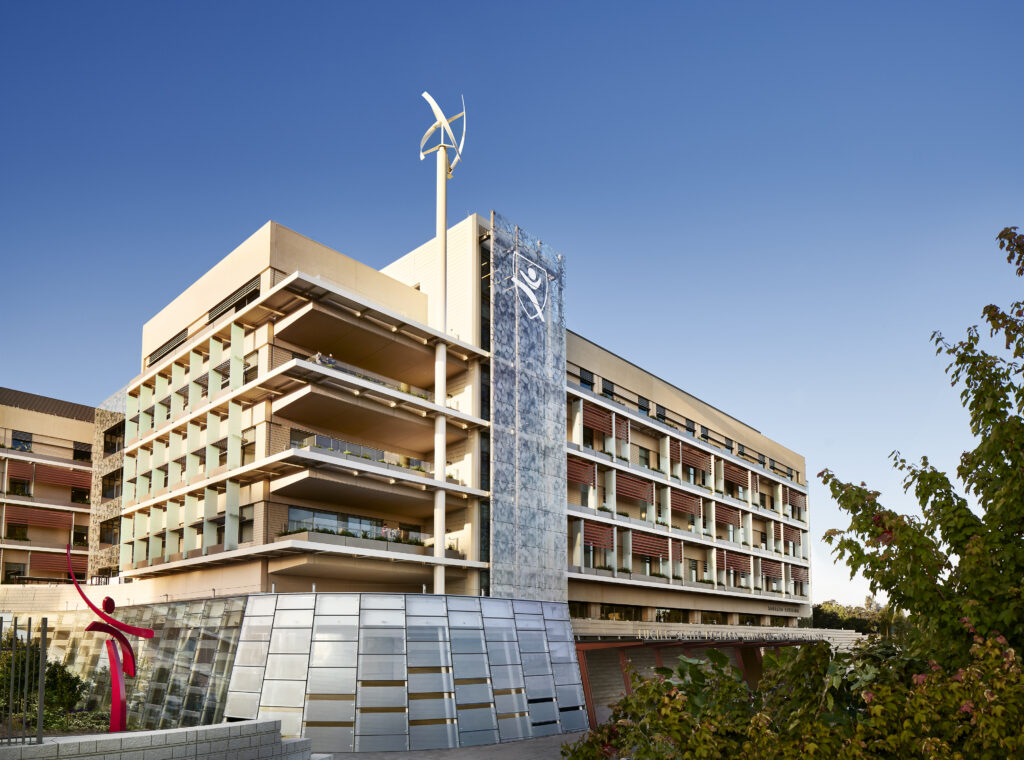
Stanford Medicine Children’s Health (SMCH) is a close partner in Stanford’s climate action efforts, with operations integrated into campus energy, utilities, and planning systems. SMCH has committed to reducing Scope 1 and 2 greenhouse gas emissions 50% by 2030 and achieving net-zero emissions by 2050, measured from a 2019 baseline. These goals align with Stanford’s long-term decarbonization pathway and support emissions reductions across shared infrastructure.
SMCH has made meaningful progress through operational and clinical initiatives, including leveraging decarbonized electricity from the Central Energy Facility, eliminating desflurane in 2023, and decommissioning bulk nitrous oxide systems, resulting in a 90% reduction in emissions from this medical gas, which has high global warming potential. Fleet improvements, enhanced energy efficiency, reduced reliance on natural gas, and planning for gas capture systems in future facilities further strengthen SMCH’s Scope 1 and 2 performance while supporting Stanford’s downstream Scope 3 reductions.
Climate action at SMCH is closely linked to community health and resilience. The hospital integrates climate considerations into community health assessments and long-term space planning, collaborates on emergency preparedness, and is planning major infrastructure transitions, including conversion from steam to district hot water and electric steam generation by 2030, reaffirming its role as a climate-responsive healthcare partner.
SLAC National Accelerator Laboratory

The SLAC National Accelerator Laboratory is a long-standing research partner advancing action through energy efficiency, electrification, and resilient infrastructure aligned with federal requirements. SLAC’s emissions are primarily tied to high-energy scientific mission support systems, which account for nearly 90% of SLAC’s electricity consumption annually. Scientific expansion will increase electricity demand over the next five years.
SLAC exceeds, based on 2025 reporting data, federal renewable electricity targets by strategic purchases that result in SLAC sourcing approximately 63% renewable electricity through a power purchasing consortium.
Operating under the Department of Energy’s Energy and Water Management Requirements, SLAC focuses efforts on conservation and efficiency across the campus of 20 conventional buildings and laboratories. Efficiency projects include using lab and grant funds to actively implement over $1 million in life cycle-cost-effective, high-bay facility lighting upgrades with advanced lighting controls.
Collaboration with Stanford is central to SLAC’s approach, including participating in lower embodied carbon and reuse initiatives, hosting Stanford student fellows focused on these topics, and operating dedicated all-electric shuttle buses through the Marguerite system. All of these efforts reinforce SLAC’s leadership in responsible research operations and its role as a valued partner.