Building Electrification

Natural gas use reduced 73% from 2011 peak levels

Natural gas is the only fossil fuel used to power building systems on campus, and its use in buildings accounts for 40% of Stanford’s total remaining Scope 1 and 2 emissions. Prioritizing electrification in buildings not only supports Stanford’s climate goals, but also complies with state regulations, such as California’s Global Warming Solutions Act (AB 32), and the United Nations climate commitment.  

About 28% of the 40% comes from standalone boilers, gas appliances, and localized heating systems serving buildings not yet connected to the Central Energy Facility’s hot water network. Historic buildings, spatial limitations, and high capital costs remain challenges, but Stanford continues to pursue pilot projects and cost-effective pathways to address them through integration with Stanford’s Capital Plan, targeted incentive programs, and coordination with upgrades to campus electrical capacity and transmission. 

The remaining 13% comes from boilers that supply high-purity steam for medical and research uses that cannot yet be served by lower-temperature systems. These operations are among the most complex and costly to electrify.

Stanford created a decarbonization planning tool that provides the solutions and costs for each building to reach complete decarbonization. Using the tool, Stanford has identified a cost-effective decarbonization pathway to eliminate 3,710 MTCO2e annually through appliance conversions and by extending the campus Low Temperature Hot Water (LTHW) system to additional buildings.

Mitigation
completed

Stanford requires all new construction to use all-electric systems for heating, cooling, and appliances or be designed electric-ready. The policy directs all projects, including renovations, to avoid adding new natural gas infrastructure and to pursue electric alternatives wherever technically and financially feasible.

Mitigation
ongoing

Between 2027 and 2033, eleven campus buildings will undergo planned renovations that eliminate gas-powered equipment and transition systems to electric alternatives. For buildings already connected to the Central Energy Facility’s Low-Temperature Hot Water system, such as Roble, Lagunita, Toyon, and Branner, these projects will enable full conversion once interior heating units are replaced. Other buildings, including Bechtel International Center, Casper Quad, Vaden Health Center, and the Golf Clubhouse, will install stand-alone electric systems for heating, cooking, and laundry. Collectively, these upgrades are expected to eliminate approximately 1,343 MTCO2e emissions.

Mitigation
planned

Between 2027 and 2035, Stanford will convert nine additional campus buildings from local natural gas boilers to the Central Energy Facility’s (CEF) Low Temperature Hot Water (LTHW) system, reducing emissions by approximately 840 metric tons of CO₂ annually. Funding for existing renovation projects can be leveraged along with an up-front contribution from the LTWH utility system. Factoring in energy efficiency benefits, a switch to lower-cost source energy, and enhancements to the LTHW system, these projects will have a positive net present value. Buildings planned for conversion include Abrams Midrise, Barnes Midrise, Studio 5, Hulme Midrise, Studio 1, Studio 3, Studio 6, & Studio 6 Commons.

planned

Process steam, primarily used to support medical and research lab equipment, accounts for ~4,000 MTCO2e annually, about 13% of the university’s Scope 1 & 2 emissions. Stanford has launched a new research initiative to look holistically at the use of steam in laboratories. The study will look at the unique needs of each laboratory process and if non-steam alternatives are available. If steam is required, the study will investigate opportunities to consolidate across multiple labs, improve processes, and produce and distribute the steam more efficiently.

Mitigation
in-progress

Discovering Steam Resource Recovery Opportunities
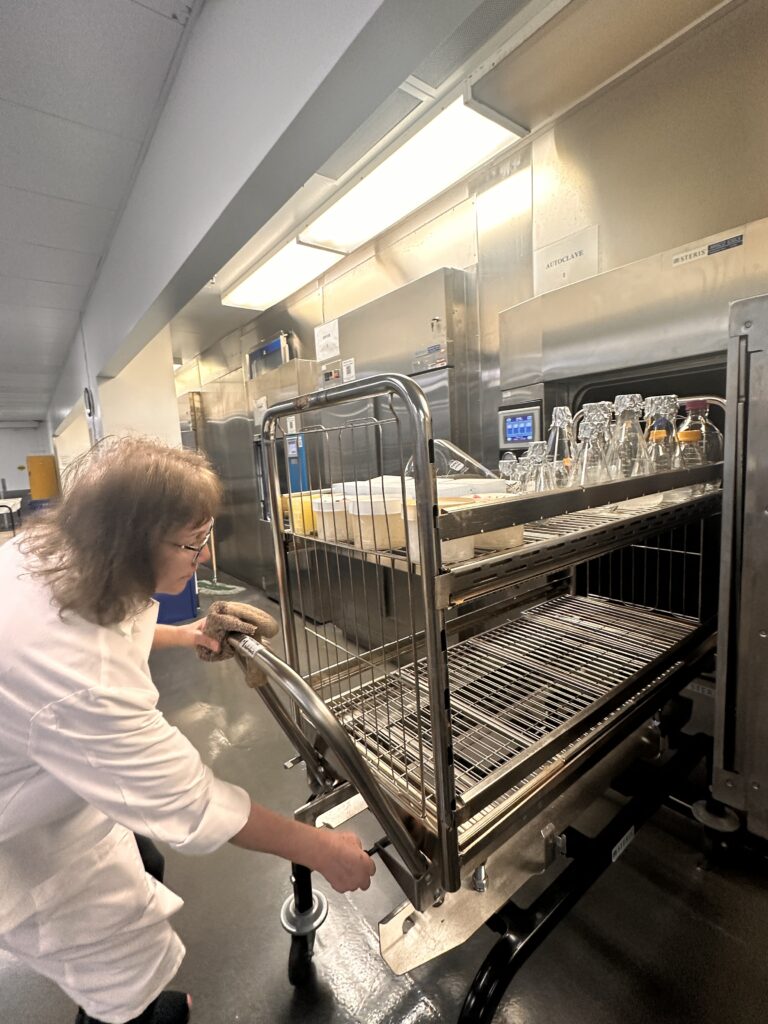
PhD student Rachel Porter, a Sustainable Stanford Living Lab Fellow, identified “hot spots” of high steam usage by analyzing building-level data. Her findings highlight a clear path toward eliminating one of Stanford’s largest remaining emissions sources through equipment upgrades, electrified steam generation, and automated monitoring.